
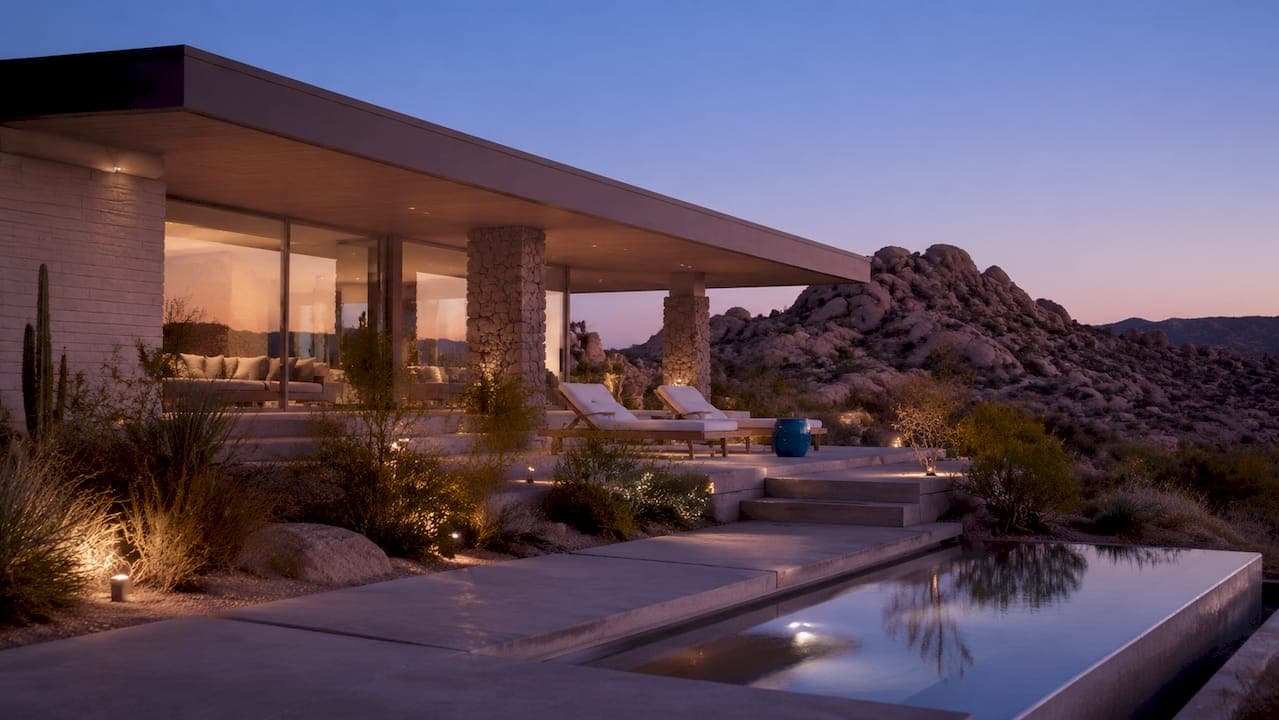
Desert modern architecture is a climate-responsive design style that adapts modernist principles to arid environments through shade, thermal mass, and indoor-outdoor flow. Born in the American Southwest during the 1930s–1950s, this approach treats the desert not as an obstacle but as the primary design brief. Today it remains one of the most copied and least fully understood residential styles in the country. If you are exploring what defines desert modern architecture for a home project or pure curiosity, this guide covers everything from its historical roots to the technologies shaping it right now.
What is desert modern architecture, really?
Desert modern architecture is defined by flat or low-pitched roofs, floor-to-ceiling glass, open floor plans, and deep overhangs engineered specifically for desert conditions. The industry term is Desert Modernism, and it sits within the broader mid-century modern movement while diverging sharply from it in one critical way: every design decision answers to climate first.
The style is not decoration. Desert Modernism prioritizes function that shapes form, meaning the building's silhouette, material palette, and window placement all emerge from solving heat, glare, and airflow problems. That constraint produces a look that feels effortless but is actually the result of precise environmental thinking.
Flat roofs and horizontal lines are not arbitrary aesthetic choices either. Horizontal profiles harmonize buildings with desert landscapes rather than compete with the horizon. The visual result is a structure that reads as part of the terrain, not imposed on top of it.
Core characteristics of desert modernism
The characteristics of desert modernism cluster around five design moves that work together as a system, not a checklist.
Flat and low-pitched roofs
Flat roofs reduce the building's exposure to direct solar radiation on vertical surfaces. They also allow for rooftop mechanical systems and, in modern builds, photovoltaic panels oriented at optimal angles. The low profile keeps the structure visually anchored to the ground plane.
Floor-to-ceiling glass and indoor-outdoor connection
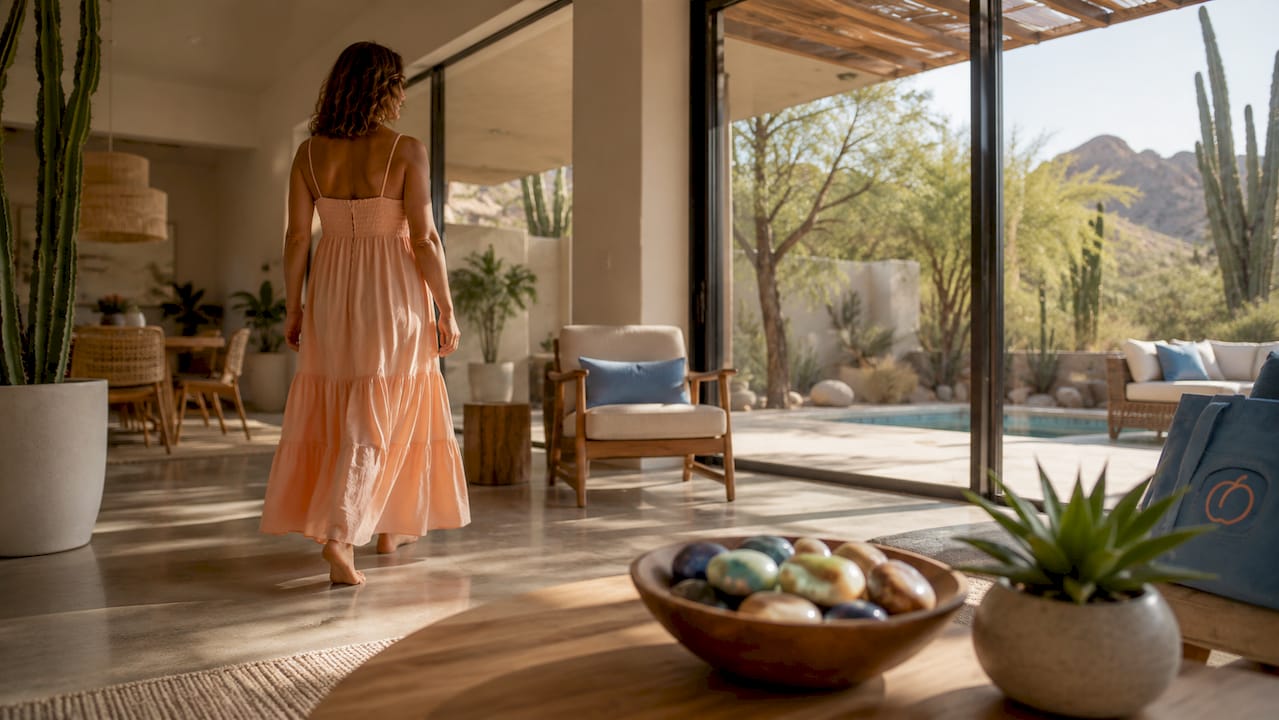
Expansive glazing in Desert Modernism is not about maximizing views for their own sake. It creates a visual and physical connection between interior living spaces and shaded outdoor areas. Sliding glass walls and pocket doors allow the interior to open completely, turning a covered patio into an extension of the living room.
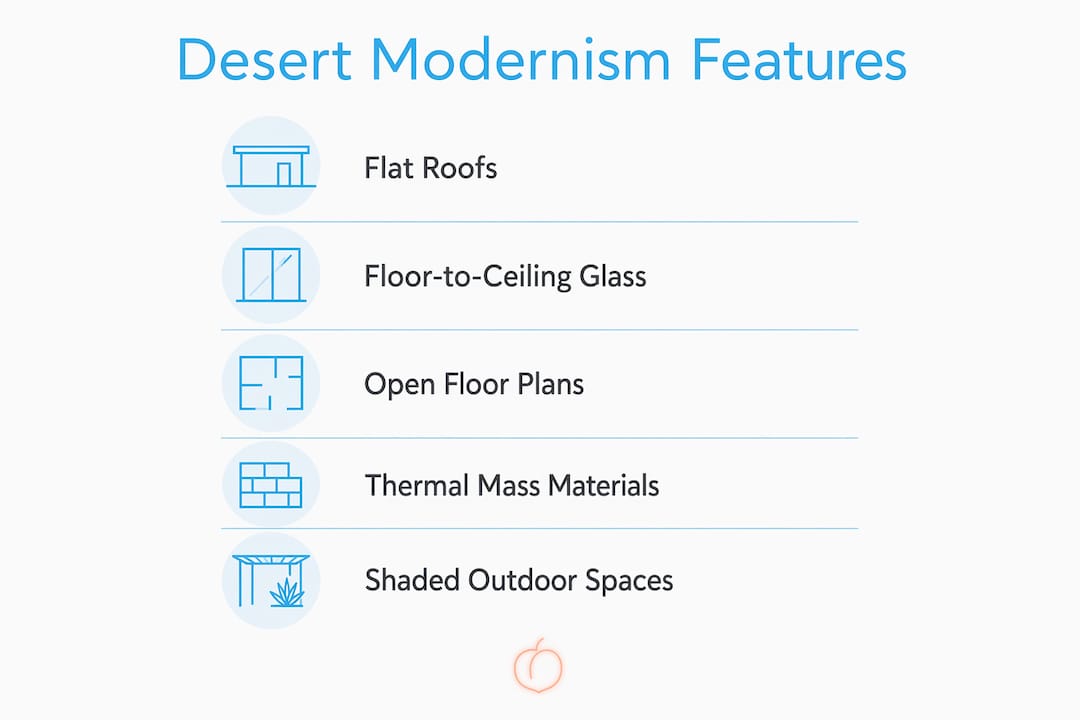
Open floor plans and thermal flow
Open plans serve a functional purpose beyond aesthetics. Fewer interior walls mean air moves freely through the home, supporting cross-ventilation strategies. Heat does not get trapped in corridors or closed rooms.
Natural and industrial materials for thermal mass
Concrete, rammed earth, stone, and concrete block are the workhorses of desert modern material palettes. These materials absorb heat during the day and release it slowly at night, buffering the dramatic temperature swings common in arid climates.
Shaded outdoor living spaces
Deep overhangs, pergolas, and covered loggias are not optional amenities. They are load-bearing elements of the climate strategy. A well-calculated overhang blocks high-angle summer sun while allowing low-angle winter light to penetrate the interior.
Pro Tip: When evaluating a desert modern home, check the overhang depth relative to window height. A ratio of roughly 1:2 (overhang depth to window height) is a reliable indicator that the designer calculated solar angles rather than guessing.
| Feature | Desert Modern | Generic Modern |
|---|---|---|
| Roof form | Flat or low-pitched | Varied, often pitched |
| Glazing strategy | Shaded, oriented to views and ventilation | Maximized without solar control |
| Material palette | Concrete, stone, rammed earth | Mixed, often lightweight cladding |
| Outdoor space | Integral, shaded, climate-managed | Decorative, often unshaded |
| Site relationship | Grows from topography | Placed on site |
Who built it? the history of desert modern architecture
The history of desert modern architecture begins in Palm Springs, California, where a confluence of wealthy clients, a severe climate, and a generation of ambitious architects produced some of the most studied residential buildings of the 20th century.
Richard Neutra arrived in Palm Springs in the 1930s and applied his European modernist training directly to desert conditions. His Kaufmann Desert House (1946) remains the canonical example: a steel-and-glass pavilion with deep roof overhangs, a reflecting pool for evaporative cooling, and a pinwheel plan that captures breezes from multiple directions.
Albert Frey brought a more austere sensibility. His Frey House II (1964), perched on a granite boulder in the San Jacinto Mountains above Palm Springs, is the clearest statement that desert architecture grows from the site, not placed arbitrarily on it. The boulder literally penetrates the interior wall.
William F. Cody and Donald Wexler pioneered problem-solving designs using sunscreens, trellises, and covered walkways as climate necessities rather than decorative additions. Wexler's steel prefab homes (1961) for Alexander Construction Company proved that industrial materials could perform beautifully in desert heat.
"Desert Modernism is less about style and more a stance responding honestly to environmental realities, favoring real materials and topography integration." — InfoArizona.com
The movement spread through Arizona, New Mexico, and Nevada through the 1960s and 1970s, adapting to local materials and microclimates. Today, architects like Kendall Heaton Associates and firms working in Scottsdale and Tucson carry the tradition forward with updated tools and materials.
How does desert architecture respond to climate?
Climate response is the engine of Desert Modernism. Every passive strategy in the toolkit addresses one of three problems: too much heat gain, too little airflow, or too much glare.
-
Roof overhang calculation. Precise overhang dimensions block high summer sun while permitting low-angle winter light. This single move reduces cooling loads significantly without any mechanical system.
-
Thermal mass placement. Concrete and stone walls on east and west exposures absorb morning and afternoon heat. The key constraint: unshaded concrete walls can radiate heat at night, so placement and shading must be modeled together, not treated as separate decisions.
-
Cross-ventilation design. Sliding walls and indoor-outdoor portals are critical cooling strategies oriented to local winds. In Palm Springs, that means aligning openings to the Banning Pass winds that funnel cool evening air through the valley.
-
Evaporative cooling through water features. Pools, fountains, and water walls lower ambient air temperature through evaporation. This is not decorative. In low-humidity desert air, evaporative cooling can drop perceived temperature by 10–15 degrees Fahrenheit.
-
Advanced glazing. Modern desert homes use low-emissivity (low-E) glass and thermally broken frames to reduce solar heat gain through windows without sacrificing the transparency that defines the style.
Pro Tip: Orient the primary glazing toward north or east in the northern hemisphere desert. South and west exposures receive the most intense afternoon sun and require the deepest overhangs or external shading devices to stay comfortable.
Natural ventilation design integrates openings aligned with prevailing winds, enhancing cross-breeze and reducing mechanical cooling needs. This is not a passive benefit. It is an engineered outcome that requires site-specific wind analysis before the floor plan is drawn.
Modern innovations shaping desert modern design today
21st-century technology has not replaced the passive strategies of Desert Modernism. It has made them more precise and more reliable.
3D energy modeling tools like EnergyPlus and Autodesk Insight allow architects to simulate solar gain, shading performance, and thermal mass behavior before breaking ground. 3D visualization reduces design risks by optimizing solar gain and shading early in the process, catching problems that hand calculations miss.
Smart home automation now controls shading, ventilation, and glazing in real time. Motorized exterior shades deploy automatically when sensors detect direct solar radiation on a window. Clerestory windows open on a timer to flush hot air at night. These systems extend the performance of passive design without replacing it.
Advanced insulated glazing units with triple-pane construction and aerogel spacers achieve U-values below 0.15, a threshold that was commercially unavailable a decade ago. This allows larger glass areas without the heat penalty that constrained mid-century designers.
| Technology | Function | Benefit in Desert Climate |
|---|---|---|
| EnergyPlus modeling | Simulates thermal performance | Catches shading and mass errors before construction |
| Low-E triple glazing | Reduces solar heat gain | Enables larger glass areas safely |
| Motorized exterior shades | Blocks direct sun dynamically | Reduces peak cooling loads |
| Smart ventilation controls | Automates night flushing | Lowers indoor temperature passively |
The synthesis of traditional passive methods with precision engineering is what separates a well-executed desert modern home from one that looks the part but performs poorly. Aesthetics without climate logic is just pastiche.
Practical advice for homeowners designing desert modern spaces
Applying desert modern design principles to a real project requires decisions that go beyond choosing the right materials.
- Start with site analysis. Map solar angles, prevailing wind directions, and topography before drawing a single line. A home oriented 15 degrees off the optimal axis can increase cooling loads by 20–30 percent.
- Choose materials for thermal performance, not just appearance. Rammed earth and concrete block are excellent thermal mass materials. Stucco over light-frame construction looks similar but performs very differently.
- Shade first, glass second. Design the overhangs and exterior shading before finalizing window sizes. Reversing this order is the most common mistake in desert modern renovations.
- Integrate outdoor living as a climate tool. A shaded courtyard or covered loggia lowers the ambient temperature around the building envelope. It is not a luxury add-on. It is part of the cooling system.
- Avoid heat-soak on west walls. West-facing concrete or masonry walls without shading absorb intense afternoon heat and radiate it into the interior through the evening. Either shade them or use lighter materials on that exposure.
For a deeper look at how site-sensitive design translates into a livable desert retreat, the desert retreat design guide at Peach-residence covers practical layout and material decisions in detail.
Pro Tip: When selecting a contractor for a desert modern build or renovation, ask specifically about their experience with thermal mass detailing. Most residential contractors understand framing and drywall. Very few understand how to detail a rammed earth wall correctly.
Key takeaways
Desert modern architecture succeeds because it treats climate as the primary design constraint, producing homes that are both beautiful and genuinely functional in arid conditions.
| Point | Details |
|---|---|
| Climate drives every decision | Roof overhangs, glazing, and materials are all calculated responses to desert heat and sun angles. |
| Thermal mass requires precision | Unshaded concrete walls can radiate heat at night, so placement and shading must be modeled together. |
| Cross-ventilation is engineered | Openings aligned with prevailing winds reduce AC dependence and are a core design element, not a bonus. |
| Modern tech enhances passive design | Tools like EnergyPlus and smart shading systems make traditional passive strategies more reliable and measurable. |
| Site analysis comes first | Solar orientation and wind mapping before floor plan design is the single most impactful decision a homeowner can make. |
Desert modernism is not a style. it is a commitment.
I have spent years studying and visiting desert modern homes across Palm Springs, Scottsdale, and Tucson, and the pattern I keep seeing is this: the ones that feel extraordinary are not the ones with the most glass or the most dramatic cantilevers. They are the ones where you walk in and immediately feel the temperature drop, the breeze move through, and the mountain view frame itself perfectly from the sofa.
That is not accident. That is a designer who understood that Desert Modernism's endurance comes from authentic materials and honest responses to the environment, not decorative stylization. The architects who built this tradition, from Richard Neutra to Albert Frey, were not making aesthetic statements. They were solving problems, and the beauty emerged from the solutions.
What I find most interesting about the current moment is how technology is closing the gap between intention and performance. Mid-century designers had to rely on intuition and rule-of-thumb calculations. Today, a competent architect can model a home's thermal behavior with the same precision a structural engineer applies to load calculations. That should produce better desert modern homes than we have ever built. The ones I see doing this well are genuinely exciting.
My honest concern is the number of homes being marketed as "desert modern" that are really just flat-roofed boxes with a lot of glass and some concrete pavers. They look the part in a listing photo. They are miserable to live in by July. If you are buying or building, push your architect on the climate modeling. Ask to see the overhang calculations. Ask how the cross-ventilation works on a still day. The answers will tell you everything.
— Rasmus
Experience desert modern architecture at Peach-residence
Reading about desert modern design principles is one thing. Living inside them is another.
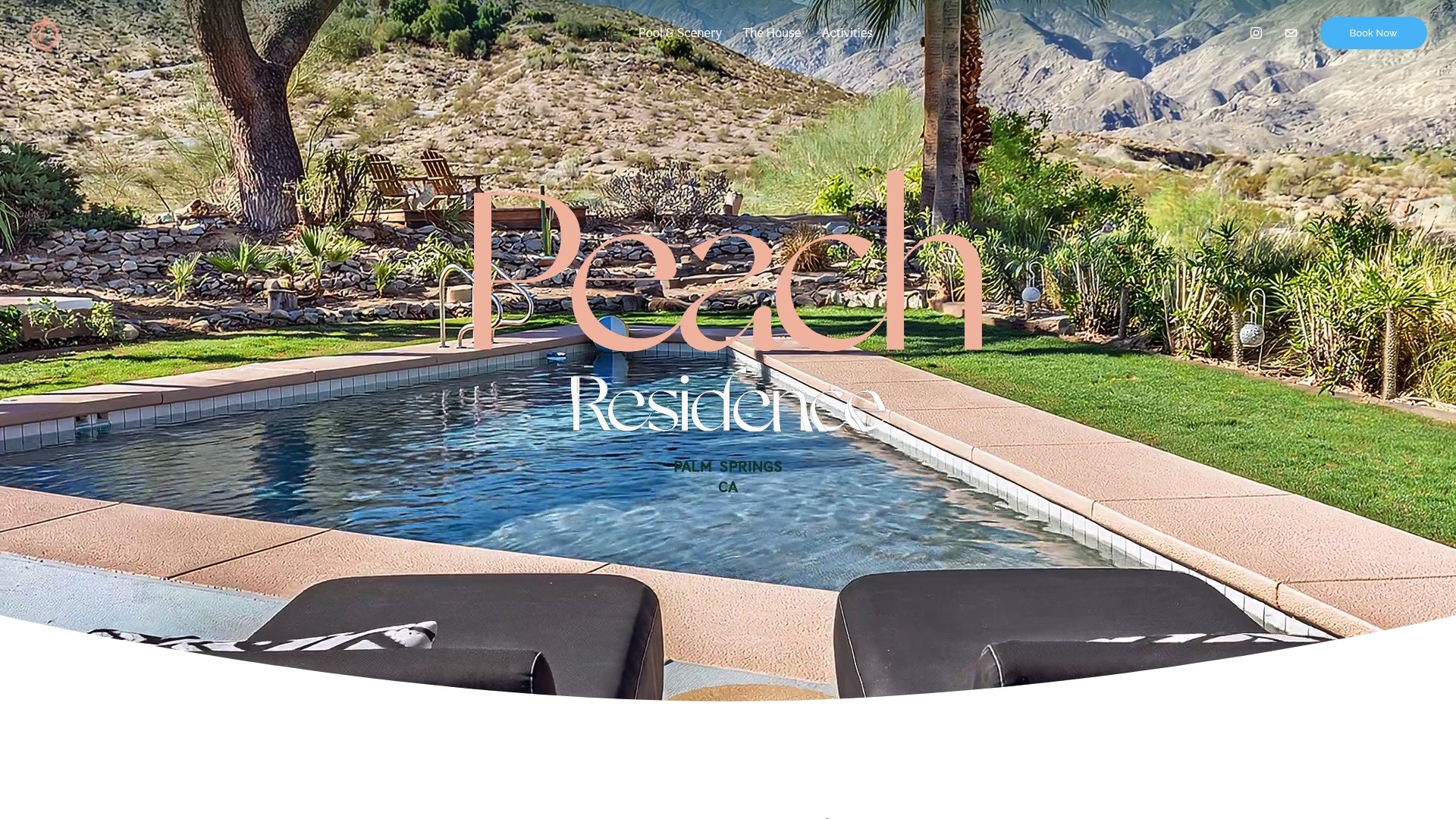
Peach-residence in Palm Springs is a freshly updated (2025) four-bedroom home that fully commits to the indoor-outdoor lifestyle that defines this architectural style. Doors open, the breeze moves through, and the mountain views frame themselves exactly the way the best desert modern homes are designed to deliver. With room for eight guests and rates starting at $65 per person per night, it is one of the most direct ways to understand what this style actually feels like from the inside. If you want to see how architecture shapes a luxury vacation experience before committing to a build or renovation, a stay at Peach-residence is the most informative research you can do.
FAQ
What defines desert modern architecture?
Desert modern architecture is defined by flat or low-pitched roofs, deep overhangs, floor-to-ceiling glass, open floor plans, and thermal mass materials like concrete and stone. Every feature responds to desert climate conditions rather than pure aesthetic preference.
Who are the key architects of desert modernism?
Richard Neutra, Albert Frey, William F. Cody, and Donald Wexler are the foundational figures of Desert Modernism, all working primarily in Palm Springs, California, during the mid-20th century.
How does thermal mass work in desert homes?
Thermal mass materials like concrete and rammed earth absorb heat during the day and release it slowly at night, buffering the large temperature swings typical of arid climates. Placement and shading must be carefully engineered to prevent unwanted heat radiation after sunset.
Is desert modern architecture sustainable?
Desert Modernism is one of the most climate-responsive residential styles in American architecture. Passive cooling strategies including cross-ventilation, shading, and thermal mass reduce mechanical cooling loads significantly when properly designed.
Where did the desert modern style originate?
The desert architecture style originated in Palm Springs, California, during the 1930s–1950s, where architects adapted European modernism to the extreme heat and light conditions of the Coachella Valley.