

Booking etiquette is defined as the set of norms and best practices travelers follow when making, managing, and honoring reservations across hotels, vacation rentals, and dining experiences. It covers everything from accurate party sizes and timely cancellations to how you communicate with hosts on platforms like Airbnb and OpenTable. Most travelers focus entirely on finding the best deal. The ones who actually get the best experience focus on how they show up before they ever arrive.
What is booking etiquette and why does it matter?
Booking etiquette is the code of conduct that governs how guests interact with hosts and service providers throughout the reservation process. It matters because every booking represents a real operational commitment on the other side. A restaurant holds a table, a vacation rental host blocks dates, a hotel allocates a room. When guests ignore the norms around these commitments, the ripple effects hit staff, other guests, and the business itself.
The hospitality industry runs on trust. Platforms like Resy and OpenTable now track guest behavior across restaurants, meaning a pattern of silent no-shows or misleading bookings can follow you. This is not a minor inconvenience. Chronic offenders get flagged and blocked from top-tier venues entirely.
Good booking etiquette also works in your favor. Guests who communicate clearly, arrive on time, and treat staff with respect consistently receive better service, more flexibility, and the kind of goodwill that turns into upgrades, preferred tables, and repeat-guest perks. The return on basic courtesy is surprisingly high.

What are the key principles every traveler should know?
The core principles of proper reservations etiquette apply whether you are booking a Michelin-starred dinner, a boutique hotel, or a private vacation rental in Palm Springs.
- Arrive on time or call ahead. Tables are held for about 15 minutes before being released to walk-ins. The same logic applies to vacation rental check-ins. If you are running late, a quick call or message is all it takes to preserve your booking and your standing.
- Report your accurate party size. Overstating group numbers to secure more space does not work. Seating is allocated based on who actually shows up, and inflated numbers disrupt food prep and table planning.
- Communicate changes immediately. Plans shift. That is fine. What is not fine is silence. Proactive messages maintain trust and allow hosts to reallocate resources to other guests.
- Understand cancellation policies before you book. Restaurant cancellation fees range from $10 to $45 per person at many venues. Vacation rentals often have stricter terms. Reading the policy is not optional.
- Disclose special needs at booking time. Dietary restrictions, accessibility requirements, and allergy information should go in the booking notes, not be announced at arrival. For fine dining especially, undisclosed restrictions at arrival disrupt kitchen flow and reduce the quality of your experience.
Pro Tip: When booking for a group, designate one person as the point of contact for the host or venue. Multiple people messaging the same host with conflicting information creates confusion and signals disorganization.
How does booking etiquette differ across hotels, rentals, and dining?
The underlying principles stay consistent, but the specific expectations shift depending on where you are booking. Understanding those differences is part of how to book properly.
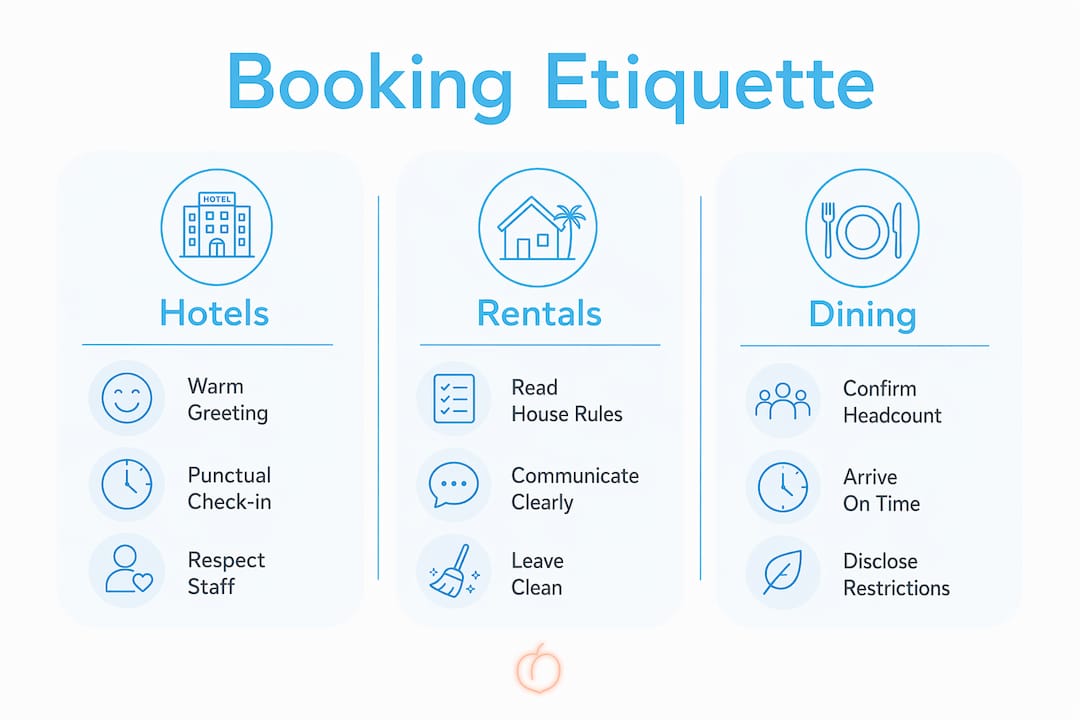
| Booking type | Key etiquette focus | Common mistake |
|---|---|---|
| Hotel | Warm interaction with staff, check-in/out timing, tipping housekeeping | Treating front desk staff as transactional rather than as hosts |
| Vacation rental | Clear host communication, respecting house rules, coordinating check-in | Ignoring the house manual and contacting the host for issues it already covers |
| Dining reservation | Punctuality, accurate party size, advance allergy disclosure | Treating the booking as a casual suggestion rather than a commitment |
Hotel booking etiquette
Hotels involve the most human touchpoints of any booking type. Etiquette expert Laura McRae notes that treating hotel staff with warmth and polite requests significantly improves service quality. Beyond attitude, the practical rules include respecting checkout times, not leaving rooms in a state that requires extraordinary cleanup, and acknowledging housekeeping. A handwritten thank you note to housekeeping staff is a small gesture that is frequently remembered, especially during longer stays.
Vacation rental etiquette
Vacation rentals operate on a host-guest relationship that is more personal than a hotel stay. The host has opened their property to you. Reading the house rules before arrival is not a suggestion. It is the baseline expectation. Coordinate your check-in time in advance, communicate any delays, and leave the property in the condition you found it. Reviewing the booking workflow before your stay helps you understand what the host expects at each stage.
Dining reservation etiquette
According to Restaurant Magazine, reservations are a formal social contract rather than a casual agreement. Restaurants plan staffing, prep, and seating around confirmed bookings. Showing up 30 minutes late without notice, or not showing up at all, costs the venue real money. If you miss your reservation, calling shortly after is still better than silence. It allows the host to potentially free the table and preserves your standing as a guest.
Pro Tip: For group dining reservations, confirm the headcount 48 hours before the booking. Restaurants often call to confirm large parties anyway. Getting ahead of that call signals reliability.
What are the most common booking mistakes travelers make?
Most booking mistakes are not malicious. They come from underestimating how much operational complexity sits behind a simple reservation. Here are the five most common errors and how to avoid them.
-
The silent no-show. Restaurant operators cite the silent no-show as their primary frustration. Not calling, not messaging, just not appearing. The fix is simple: cancel as early as possible, and if you miss the window, call anyway.
-
Inflating party size. Booking for eight when six are coming seems harmless. It is not. The venue sets up for eight, preps for eight, and staffs for eight. When six arrive, the mismatch creates waste and confusion. Book for the actual number attending.
-
Failing to disclose special needs. Announcing a severe nut allergy at the table in a fine dining restaurant is not a reasonable request. It is a disruption. Disclose allergies, dietary restrictions, and mobility needs at the time of booking so the host can prepare properly.
-
Ignoring cancellation terms. Many travelers book without reading the cancellation policy, then are surprised by fees. Understanding the cancellation terms before confirming a reservation is a non-negotiable part of how to book properly. Fees exist because no-shows have real costs.
-
Stacking overlapping reservations. Booking multiple restaurants or rentals for the same date as a backup plan, then canceling last-minute, is a pattern that booking platforms now track. It wastes resources and damages your guest profile on systems that share behavior data across venues.
How can you practice excellent booking etiquette?
Excellent travel booking guidelines come down to treating every reservation as a commitment, not a placeholder. These practices apply across accommodation types and dining situations.
- Confirm close to your arrival date. A quick confirmation message 24 to 48 hours before your stay or reservation signals reliability and gives the host a chance to flag anything you need to know.
- Communicate changes through the booking platform. Whether you use Airbnb, OpenTable, or a direct booking system, keeping communication on the platform creates a record and makes it easier for the host to manage.
- Use polite, specific language when requesting adjustments. "Could we arrange an early check-in?" lands better than "We need to check in at noon." Specificity helps the host say yes or offer a real alternative.
- Show appreciation in concrete ways. Tipping housekeeping, leaving a genuine review, and sending a thank you message after a vacation rental stay all contribute to a positive guest profile. These gestures cost nothing significant and build real goodwill.
- Book in advance for groups or special occasions. Large groups require more coordination from the host. For group travel accommodations, booking early and communicating your needs upfront gives everyone a better experience.
Pro Tip: When booking a vacation rental for a group, read the house rules out loud to the group before arrival. It takes five minutes and prevents the kind of misunderstandings that lead to security deposit disputes.
Key takeaways
Booking etiquette is the single most underused tool travelers have for improving their hospitality experiences, and it costs nothing to practice.
| Point | Details |
|---|---|
| Punctuality is non-negotiable | Most venues hold reservations for only 15 minutes before releasing them to other guests. |
| Honest party sizes serve everyone | Accurate headcounts allow hosts to prepare correctly and deliver better service. |
| Silent no-shows have real consequences | Booking platforms track behavior, and chronic offenders risk being blocked from top venues. |
| Disclose special needs at booking time | Announcing allergies or restrictions at arrival disrupts operations and reduces your experience quality. |
| Communication is the core skill | Proactive messages about delays or changes preserve goodwill and protect your guest standing. |
Why booking etiquette is the most underrated travel skill
Most travel advice focuses on where to go and what to pack. Almost none of it covers how to behave as a guest before you arrive. That gap is where a lot of travel experiences quietly fall apart.
I have seen it from both sides. Guests who communicate clearly, show up when they say they will, and treat the people serving them as actual humans consistently have better trips. Not because they got lucky. Because they created the conditions for good service. A host who trusts you is a host who goes the extra mile.
The part that surprises most people is how little it takes. Calling ahead when you are running late, reading the house rules before check-in, disclosing a food allergy when you book. These are not grand gestures. They are small signals that tell the host you take the relationship seriously.
What I find genuinely underestimated is the operational complexity behind a single booking. A vacation rental host coordinates cleaning crews, key handoffs, and supply restocking around your arrival time. A restaurant maps its entire floor plan around confirmed reservations. When guests treat bookings as casual suggestions, they are not just being inconsiderate. They are creating real operational failures for people doing real work.
Good etiquette is not about being formal or stiff. It is about recognizing that a booking is a two-way commitment. You get the experience you came for. The host gets the reliability they need to deliver it. That exchange works when both sides hold up their end.
— Rasmus
Book your next stay the right way at Peach-residence

Peach-residence in Palm Springs is built for guests who know how to travel well. Four bedrooms, mountain views with no city noise, and a layout designed for groups of up to eight people who want space, privacy, and that signature indoor/outdoor Palm Springs feel. The booking process is direct and transparent, with clear house rules and a host who actually responds.
If you are planning a group trip, the Palm Springs group guide covers everything you need to coordinate a smooth stay. Ready to see the property? Explore the house and check availability directly. From $65 per person per night, it is one of the better-value private rentals in the desert.
FAQ
What is the standard grace period for a reservation?
Most restaurants hold tables for about 15 minutes before releasing them. Hotels and vacation rentals vary, but notifying your host if you will be late is expected regardless of the grace window.
Can a restaurant charge me for not showing up?
Yes. Cancellation fees at restaurants range from $10 to $45 per person and are increasingly standard at mid-range and high-end venues. Always read the cancellation policy before confirming.
What happens if I book the wrong party size?
Booking a larger party than you have does not secure more space. Seating is allocated on actual arrival numbers, so inflated bookings create confusion without any benefit to the guest.
When should I disclose dietary restrictions?
Disclose dietary restrictions and allergies at the time of booking, not at the table. For fine dining especially, undisclosed restrictions at arrival disrupt kitchen preparation and reduce the quality of your meal.
Does bad booking behavior follow me across platforms?
It can. Booking systems like Resy and OpenTable track guest history and share behavior data, meaning chronic no-shows or policy violations can result in being blocked from top-tier venues.