

Planning a vacation with a crew of eight, a multigenerational family, or a tight-knit group of friends sounds exciting until you realize everyone is booking their own room at different rates, on different floors, with no coordination whatsoever. That's exactly why book for groups matters as a strategy rather than just a preference. Group bookings consolidate your reservations under one organizer, unlock negotiated pricing, and create the kind of shared experience that solo or fragmented bookings simply cannot replicate. This guide covers every angle of group travel booking, from real cost savings and contract traps to the perks most travelers never think to ask for.
Table of Contents
- Key takeaways
- Why book for groups: the real financial case
- Logistics and coordination: what actually makes it work
- Understanding group contracts and deposit terms
- Extra perks and how to negotiate them
- My honest take on group booking as an organizer
- Plan your next group stay at Peach-residence
- FAQ
Key takeaways
| Point | Details |
|---|---|
| Real savings are available | Group hotel rates typically run 20% to 30% lower than standard individual rates. |
| One organizer changes everything | Consolidated billing and a single point of contact removes most coordination headaches for family and friend groups. |
| Contracts have hidden traps | Attrition clauses can require payment for up to 80% of committed rooms even if some go unused. |
| Perks go beyond room discounts | Complimentary upgrades, waived fees, and flexible name changes are all negotiable in a group booking. |
| Early planning wins every time | Booking early expands your negotiating leverage and gives your group maximum flexibility on deposits and deadlines. |
Why book for groups: the real financial case
Most people assume group bookings are only for corporate retreats or wedding blocks. That assumption costs real money. The benefits of group bookings are just as powerful for ten friends sharing a desert getaway as they are for a sales conference, and in some cases even more so because leisure groups have more flexibility in timing and destination.
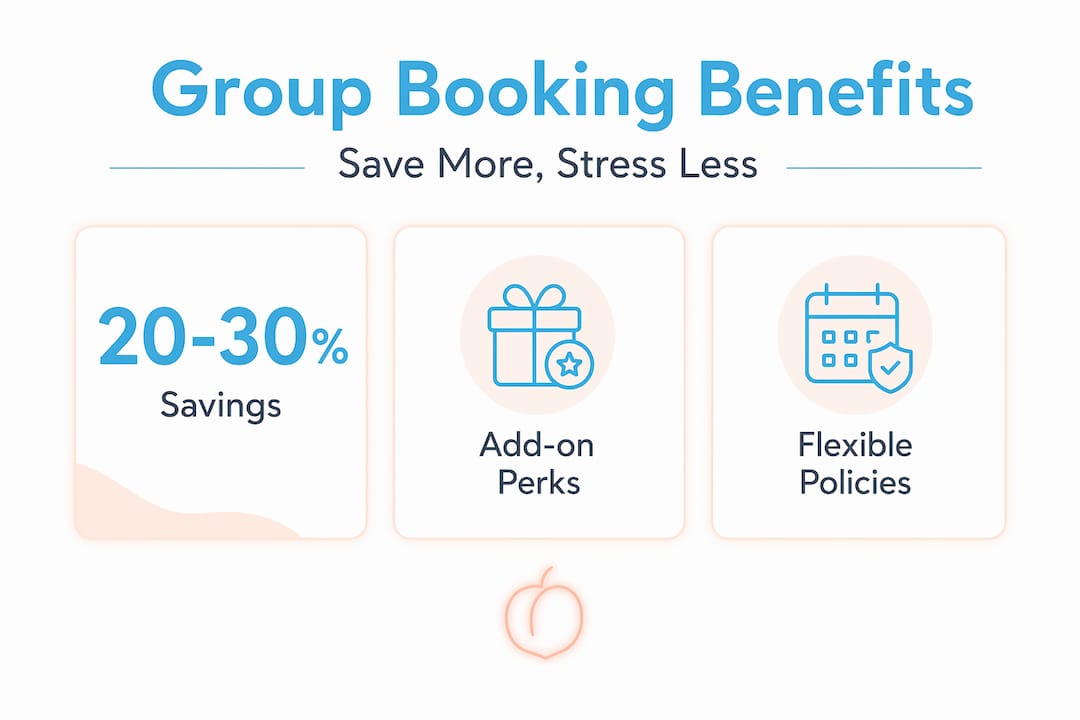
The core financial mechanic is simple. Hotels and rental properties set aside a block of rooms or a full property at a negotiated rate in exchange for a guaranteed headcount. Because you are committing volume, the provider has less risk of empty inventory, and they pass some of that security back to you as a discount. Hotel group rates typically land between 20% and 30% below standard booking rates, with some properties going significantly lower during off-peak periods. A real example: 24% off at a Moxy Brooklyn group block, and up to 62% off at Honor's Haven Resort for a group booking in 2026.
Beyond the headline discount, the advantages of booking in groups include add-ons that reduce your total trip cost without appearing as a line item. Think complimentary rooms at certain group sizes, waived resort fees, free parking, or a food-and-beverage credit that covers your welcome drinks. These extras rarely appear in the initial quote. You have to ask, which is one reason having a single confident organizer matters so much.
Here is a quick comparison of what a group of eight typically pays across different booking approaches:
| Booking approach | Average nightly rate per room | Extras included | Total flexibility |
|---|---|---|---|
| Individual standard booking | Full rack rate | None | Full, no commitment |
| Online platform group | 5% to 10% off | Minimal | Limited cancellation |
| Negotiated group block | 20% to 30% off | Often yes (parking, upgrades) | Structured contract terms |
| Whole-property rental | Flat per-person rate | Fully shared amenities | Property-specific policy |
Pro Tip: Book your group accommodations at least four to six months in advance for peak travel seasons. The further out you commit, the more leverage you have to negotiate rate reductions and add-ons before the property fills its inventory.
Logistics and coordination: what actually makes it work
Here is an uncomfortable truth about group travel: most failures come from coordination problems, not from anything the hotel or property does wrong. Delayed decisions, vague cost communication, and nobody wanting to take the lead are the actual culprits behind group trips that fall apart before departure.
A group booking consolidates all reservations under one contract and one organizer. That single structure forces clarity. There is a person responsible for deadlines. There is one billing account. There is one phone number the property calls when something changes. For families planning vacations together, this is especially valuable because it removes the "who is handling what?" ambiguity that derails so many well-intentioned trips.
The reasons to book as a group from a logistics standpoint come down to a few non-negotiable realities:
- Single point of contact: One organizer handles all communication with the property, reducing miscommunication and version-control problems across the group.
- Consolidated billing: Instead of eight separate transactions, the group pays through one account or splits costs through one invoice, which using centralized tools makes significantly easier.
- Headcount management: The organizer controls the rooming list and can make changes within the contract window without affecting each individual's reservation.
- Payment schedule clarity: Everyone knows the deposit deadline, the final payment date, and the per-person cost from day one.
The hidden stress in group bookings almost always traces back to two things: slow headcount confirmation and unclear per-person cost communication. Address both in writing before anyone commits to a single dollar.
Pro Tip: Assign specific roles within the group. One person handles vendor communication, another manages money collection, and a third keeps the group chat organized. Read more about group travel coordination to see how role clarity transforms the planning process.

Understanding group contracts and deposit terms
Group contracts look different from a standard hotel reservation, and the differences matter financially. If you skip over the details, you can end up paying for rooms your group never used.
Here are the four contract terms every group organizer needs to understand before signing:
-
Deposit amount and refundability. Group deposits commonly run between 25% and 50% of the total booking value, and they are often non-refundable. Final payments are usually due 30 to 60 days before arrival. Know this going in, not after you have committed.
-
The cutoff date. This is the deadline for your group members to book within your reserved block. After this date, the property releases unbooked rooms to general inventory, often at higher rates. Miss this date and some of your group loses the group rate entirely, and in some contracts, independent bookings outside the block forfeit the negotiated pricing.
-
The release date. This is your last chance to reduce your contracted room count without penalty. If you know by this date that four people dropped out, you can release those rooms. If you miss it, you likely still owe for them.
-
Attrition clauses. These are the most misunderstood terms in any group contract. Attrition clauses often require payment for 80% or more of your committed rooms even if your group ends up smaller than planned. Negotiate this percentage down before signing, or build enough buffer into your headcount that you are comfortable with the risk.
Why book for family groups with a careful eye on contracts? Because families often deal with last-minute cancellations, changing travel dates, and unexpected budget constraints. A stiff attrition clause turns a fun family trip into a financial headache. Always ask the property what flexibility they can offer, and get any concessions in writing.
Extra perks and how to negotiate them
Price is only part of the story. The importance of group travel deals goes beyond what appears on the invoice, and knowing how to negotiate the non-rate perks is what separates experienced group organizers from first-timers.
The advantages of booking in groups include a category of benefits that properties rarely advertise upfront:
- Complimentary room upgrades: Many properties offer a free suite or upgraded room for the group organizer at certain booking thresholds.
- Waived fees: Resort fees, parking fees, and early check-in fees are all negotiable for groups. Ask directly and specifically.
- Flexible name changes: For groups traveling with airline bookings, airline group programs allow passenger name substitutions up to ticketing deadlines, which is a significant advantage when your group roster shifts in the weeks before departure.
- Dedicated check-in: Large groups can often request a private or expedited check-in process, cutting down on lobby confusion when twelve people arrive at the same time.
- Activity or dining credits: Properties value groups as a revenue source well beyond room charges, and presenting your group's total value including meals, activities, and event spend increases your chances of receiving complimentary extras.
The last point is worth emphasizing. Hotels and vacation rental managers respond better to groups that frame themselves as full-property revenue opportunities rather than just room-night buyers. When you say "Our group of eight will be spending on catering, the pool, activities, and potentially a farewell dinner," you become more valuable to the property. That value translates into concessions you would never get as an individual booker. For more on this approach, the Palm Springs group rental benefits guide covers how to frame your group's spending power effectively.
Pro Tip: Always ask for a written list of every complimentary item or waived fee the property agreed to. Verbal agreements evaporate. Written confirmation holds.
My honest take on group booking as an organizer
I have coordinated enough group bookings to tell you the version of this experience that nobody warns you about. You will spend a surprising amount of emotional energy on things that have nothing to do with the property. Chasing payment from one person in the group is more draining than any contract negotiation.
What I have learned is that the organizer role needs to be claimed, not assumed. When everyone thinks someone else is leading, early engagement with providers never happens, deadlines slip, and the group loses the rates it was trying to capture. Volunteer explicitly. Set your own internal deadlines two weeks ahead of every actual contract deadline. That buffer has saved me from penalty fees more than once.
The contract details I used to skim are now the first things I read. Attrition clauses cost groups real money every year because organizers assume good intentions will be enough. They are not. Read every line, negotiate what you can, and go in with a headcount that you are genuinely comfortable paying for even if a few people bail.
Here is what I think people underestimate about group travel: the benefits of group bookings are not just financial. Staying in the same place, waking up together, sharing a kitchen or a pool without coordinating across three different hotels, that is the actual product. The cost savings pay for the upgrade. The shared space creates the memory. Get the logistics right and the rest takes care of itself.
— Rasmus
Plan your next group stay at Peach-residence

If you are planning a group vacation for eight people and want to skip the coordination chaos entirely, Peach-residence in Palm Springs was built for exactly this. Four bedrooms, one whole property, and mountain views that require no filter and no explanation. Starting at $65 per person per night, the per-person math works out better than booking separate hotel rooms and infinitely better when you factor in shared living space, a private outdoor area, and zero resort fees.
Explore the house to see room layouts, amenities, and availability, and check out the activities page to start building your group itinerary before you even arrive. Peach-residence keeps the booking process clear and direct, which is exactly what a group organizer needs.
FAQ
Why is group booking better than booking individually?
Group bookings typically save 20% to 30% on accommodation costs while also consolidating billing and communication under one organizer. They also unlock perks like complimentary upgrades and waived fees that individual bookings rarely offer.
What is an attrition clause in a group booking contract?
An attrition clause requires payment for a set percentage of committed rooms, often 80%, even if your group ends up smaller than planned. Negotiating this clause before signing is one of the most important steps in group travel booking.
How early should a group book accommodations?
Booking four to six months ahead for peak seasons gives groups the most negotiating leverage on rates and contract terms. Earlier commitments also allow more time to confirm headcount and communicate per-person costs clearly.
What perks can a group actually negotiate?
Groups can negotiate complimentary room upgrades, waived parking and resort fees, dedicated check-in, dining credits, and flexible name changes on airline bookings. Presenting your group as a full-property revenue source, not just room bookings, significantly improves your negotiating position.
How does a whole-property rental compare to a hotel room block for groups?
A whole-property rental like Peach-residence offers a flat per-person rate with fully shared amenities and no fragmented billing, making it simpler for groups of eight than managing a hotel room block with individual deposits and cutoff dates.