
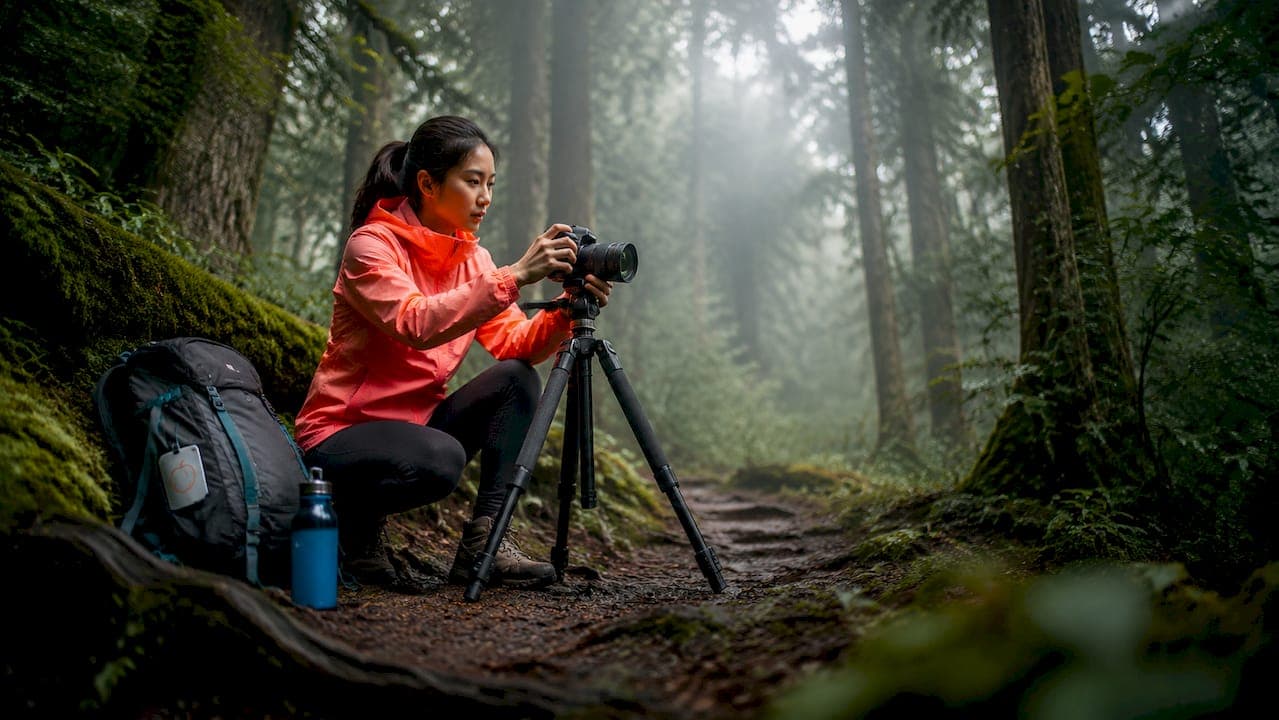
Mountain view photography is the practice of capturing mountain landscapes with technical precision and artistic intent. The best shots combine the right camera settings, deliberate composition, and an understanding of how light behaves in high-altitude terrain. Tools like PhotoPills, a circular polarizing filter, and wide-angle lenses in the 16–35mm range are standard gear for serious landscape photographers. Whether you shoot with a Sony A7R V, a Nikon Z 9, or a Canon EOS R5, the principles in these mountain view photography tips apply across every system.
1. What are the best camera settings for mountain landscapes?
Optimal aperture for mountain landscapes sits between f/8 and f/11. That range delivers the sharpest depth of field without triggering diffraction, which softens fine detail at apertures smaller than f/16.
Set your ISO to the base level of your camera. On Nikon Z 7, Z 8, and Z 9 bodies, that means ISO 64. On most other mirrorless systems, ISO 100 is the floor. Lower ISO means less noise and more dynamic range, which matters when you're pulling shadow detail from a dark valley below a bright sky.
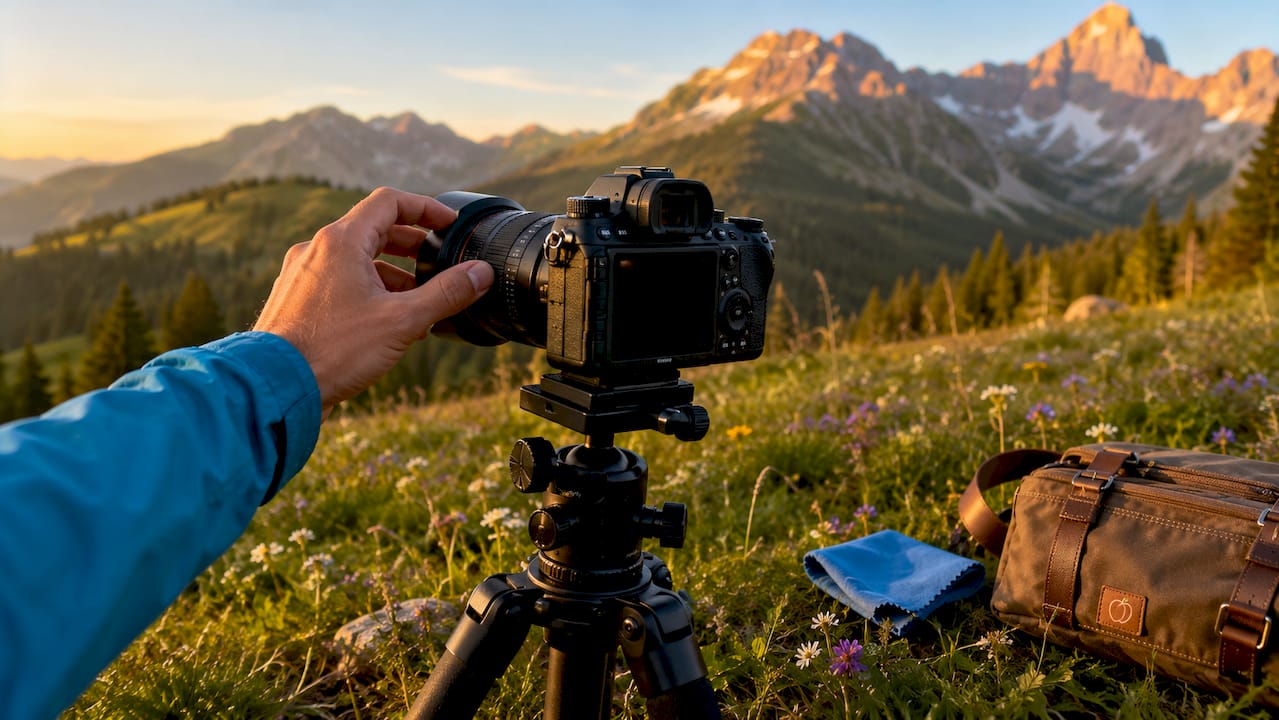
Use a tripod with at least a 4kg payload capacity. That stability lets you shoot at slow shutter speeds, sometimes 2 seconds or longer, without camera shake ruining fine edge detail on distant ridgelines.
For focus, skip autofocus guesswork. Manual focus using live view zoom, targeting a point one-third into the frame, gives you reliable sharpness across the full scene. This approach outperforms hyperfocal distance calculators on high-resolution sensors where small focus errors become visible.
Pro Tip: Always shoot RAW. Mountain scenes have extreme dynamic range, and RAW files give you the latitude to recover blown highlights in clouds and lift shadow detail in foreground rocks during post-processing.
Key settings at a glance:
- Aperture: f/8 to f/11
- ISO: 64 (Nikon Z series) or 100 (most other systems)
- Shutter speed: as slow as needed with a tripod
- Focus: manual, one-third into the frame via live view
- Format: RAW
2. How can thoughtful composition enhance mountain photography?
The three-layer composition method uses foreground, mid-ground, and background to build visual depth. A flat image with only a distant peak reads as a snapshot. Add a riverbank, a field of wildflowers, or a cluster of boulders in the foreground, and the viewer's eye travels through the frame.
Foreground interest is not optional. Anchoring mountain scenes with a strong foreground element prevents photos from appearing flat. When the sky lacks drama, shift your horizon to the upper third of the frame to give the earth elements room to breathe.
Lens choice shapes the story you tell. Wide-angle lenses in the 16–35mm range exaggerate the foreground and create sweeping vistas. Telephoto lenses in the 70–200mm range compress distance, stacking mountain layers on top of each other for a different kind of drama.
Pro Tip: Look for natural leading lines. A river cutting through a valley, a ridge line angling toward a peak, or a trail winding into the distance all pull the viewer deeper into the image.
Additional composition strategies worth practicing:
- Shoot vertical frames to emphasize height and depth in tall peaks
- Use negative space in a plain sky to isolate a dramatic summit
- Stitch panoramas for ultra-wide scenes that a single frame cannot contain
- Frame peaks through natural arches, tree canopies, or rock formations
3. Why is timing and natural light critical for mountain scenes?
Golden hour light defines mountain photography. Directional light at sunrise and sunset rakes across ridgelines, creating shadows that reveal texture and form. Midday light falls straight down, flattening those same ridges into featureless gray shapes.
Alpenglow is the most fleeting and rewarding light event in mountain photography. Alpenglow lasts only 7–20 minutes, and it requires you to be fully set up before it begins. Arriving 45 minutes before sunrise gives you time to scout your position, set your exposure, and compose before the light changes.
Blue hour, the 20–30 minutes before sunrise and after sunset, produces cooler, softer light with a distinct mood. It works especially well for mountain lakes and snow-covered peaks where the blue cast feels natural rather than cold.
Weather adds drama that no filter can replicate. Clouds rolling through a valley, morning mist clinging to a forest below the treeline, and atmospheric haze layering distant peaks all create images that clear-sky days cannot produce. A circular polarizing filter cuts through that haze, revealing distinct mountain layers that would otherwise blend together.
Use PhotoPills to predict exactly where the sun or moon will rise relative to your chosen peak. That planning turns guesswork into a repeatable process.
4. How can planning and gear preparation improve your results?
Pre-trip planning separates photographers who get the shot from those who almost got it. Arriving 45 minutes before sunrise gives you time to set up, meter the scene, and adjust composition before the light you came for appears and disappears.
Apps like PhotoPills and Windy handle two critical variables: sun and moon position, and weather. PhotoPills shows you exactly where the sun will rise over a specific peak on a specific date. Windy gives you wind speed and cloud cover forecasts that tell you whether the morning will be clear or dramatic.
Gear simplicity is a real advantage in mountain terrain. Pre-setting exposure and focus before you start hiking means you are not fumbling with menus when the light breaks. Gear-lock, the paralysis of adjusting settings instead of shooting, costs you images.
Your core kit for mountain photography:
- Tripod with 4kg+ payload capacity
- Circular polarizing filter
- Wide-angle lens (16–35mm) and a telephoto (70–200mm)
- Remote shutter release to eliminate camera shake
- Spare batteries (cold temperatures drain batteries fast)
- Weather-sealed body and bags for rain and dust
Pro Tip: Check prime photography locations in your target region before you travel. Knowing the best vantage points in advance means you spend your golden hour shooting, not searching.
5. What advanced techniques can take mountain photos further?
Long exposure photography transforms mountain scenes. Slow shutter speeds on windy days blur moving clouds into streaks, giving still landscapes a painterly, dynamic quality. The same technique applied to a mountain stream or waterfall adds motion to a scene that would otherwise be static.
Focus stacking solves a problem that wide-angle mountain photography creates. When your foreground element is close and your peak is miles away, no single aperture keeps both sharp. Focus stacking merges multiple images captured at different focus points, producing sharpness from the rock at your feet to the summit on the horizon. Software like Adobe Photoshop and Helicon Focus automates the blending process.
Silhouettes at sunrise and sunset offer a different creative direction. Instead of exposing for the mountain, expose for the sky. The peak becomes a black shape against a gradient of orange, pink, and purple. This works best with a clean, recognizable summit profile.
| Technique | Best conditions | Key tool |
|---|---|---|
| Long exposure | Wind, moving clouds or water | Tripod, ND filter |
| Focus stacking | Wide foreground, distant peak | Adobe Photoshop, Helicon Focus |
| Panorama stitching | Ultra-wide vistas | Nodal slide, Lightroom |
| Silhouette | Dramatic sky, clean summit profile | Spot metering |
| Burst mode | Moving clouds, wildlife | High-speed drive mode |
Burst mode captures fleeting moments that a single frame misses. Clouds move fast at altitude. A burst of 5–10 frames over 2 seconds gives you options when the light breaks through a gap in the overcast.
6. How to use a polarizing filter for mountain clarity
A circular polarizing filter reduces atmospheric haze and enhances color saturation in distant mountain scenes. The effect is most visible when you shoot at roughly 90 degrees to the sun. Rotate the filter until haze drops and the blue sky deepens, then lock it in place.
Polarizers also cut reflections on mountain lakes, letting you see the lakebed or the reflected peak with equal clarity. That dual function makes the polarizer the single most useful filter in mountain photography, more so than any graduated ND filter in most conditions.
The filter costs you roughly 1.5 to 2 stops of light. That is not a problem when you are on a tripod. It becomes a problem in low light if you are trying to handhold. Know when to remove it.
Sunrise and sunset photography in mountain terrain rewards photographers who understand how polarizers interact with warm light. At golden hour, the filter can shift warm tones cooler. Use it selectively and check your histogram after each adjustment.
Key takeaways
The most effective mountain view photography combines pre-dawn planning, apertures between f/8 and f/11, and compositional depth built from foreground to background.
| Point | Details |
|---|---|
| Camera settings | Shoot at f/8 to f/11, base ISO, and RAW format for maximum sharpness and editing range. |
| Timing and light | Arrive 45 minutes before sunrise to capture alpenglow, which lasts only 7–20 minutes. |
| Composition depth | Use foreground elements, leading lines, and three-layer framing to build visual depth. |
| Gear preparation | Carry a tripod, circular polarizer, and pre-set your exposure before reaching your location. |
| Advanced techniques | Use long exposure, focus stacking, and burst mode to capture motion and full-scene sharpness. |
What I've learned from years of shooting in the mountains
The single biggest shift in my mountain photography came when I stopped treating gear as the solution. I used to arrive with every filter, every lens, and every accessory I owned. I spent the first 20 minutes of golden hour sorting through a bag instead of shooting. The light was gone before I made a single frame worth keeping.
Now I arrive with three lenses, one filter, and a pre-set camera. Everything is dialed in before I leave the trailhead. That mental readiness, as pre-setting gear before difficult terrain confirms, matters more than having every piece of equipment available.
The other lesson is patience with weather. My best mountain images came on mornings I almost stayed in bed. A forecast showing 60% cloud cover is not a reason to skip the shoot. It is a reason to go. Clouds create the drama that clear skies cannot. I have stood in light rain, watched a gap open in the overcast, and captured alpenglow on a snow-covered peak that I will never replicate on a perfect day.
Pre-visualization is the skill nobody talks about enough. Before I hike to a location, I study it on PhotoPills, Google Earth, and photography-to-design references that show how light moves across specific terrain. I know what I want before I arrive. That clarity lets me respond to what actually happens instead of reacting to it.
— Rasmus
Photograph the desert mountains from Peach-residence
Peach-residence sits at the end of a quiet cul-de-sac in Palm Springs with mountain views that stop you mid-sentence. No city light interference, no noise, just open desert sky and the San Jacinto range filling your frame from every window.
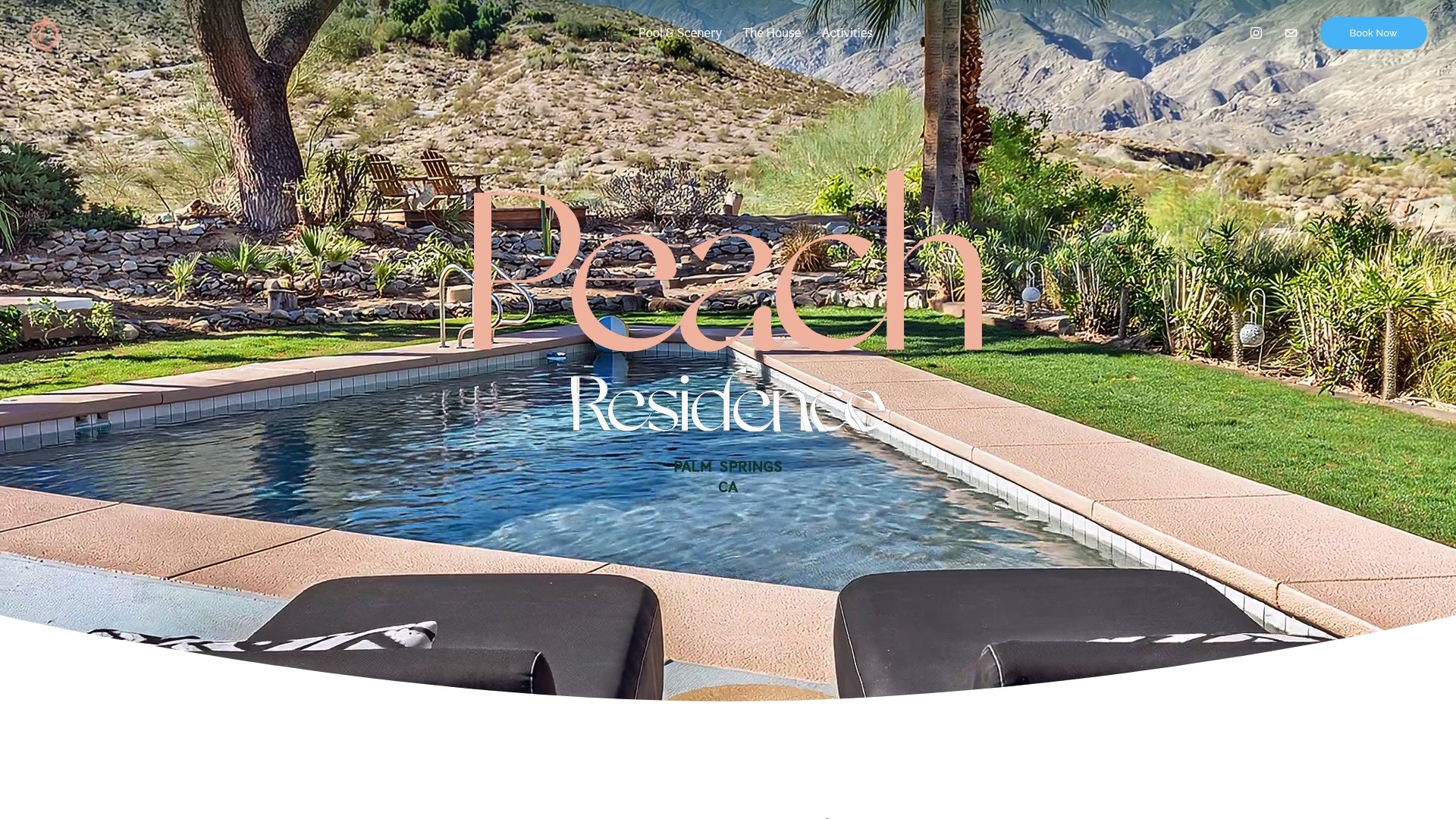
The property sleeps 8 across four bedrooms and was fully updated in 2025. It is built for the Palm Springs indoor/outdoor lifestyle, which means doors open onto the views you came to photograph. Golden hour hits the mountains directly from the main living areas. You do not need to hike to find the shot. For photographers who want a scenic mountain stay as a base, Peach-residence starts at $65 per person per night. Learn more about why mountain views make Palm Springs worth the trip.
FAQ
What aperture is best for mountain landscape photography?
The optimal aperture for mountain landscapes is f/8 to f/11. This range maximizes sharpness and depth of field without the diffraction softening that occurs at f/16 and smaller.
How early should I arrive for mountain sunrise photography?
Arrive at least 45 minutes before sunrise. Alpenglow can begin and end within 7–20 minutes, so you need to be fully set up and composed before it starts.
Do I need a tripod for mountain photography?
A tripod is not optional for serious mountain photography. Slow shutter speeds, low ISO settings, and long exposures all require a stable platform, and a tripod with a 4kg+ payload capacity handles the job reliably.
What is focus stacking and when should I use it?
Focus stacking merges multiple images shot at different focus points into one fully sharp image. Use it when your foreground subject is close and your background peak is far, making a single focus point insufficient.
Does a polarizing filter really make a difference in mountain photography?
A circular polarizing filter removes atmospheric haze and deepens sky color in mountain scenes. It also cuts reflections on mountain lakes, making it one of the most practical filters you can carry on any mountain shoot.