

Most people assume a Palm Springs vacation rental means either a luxury compound with a waterfall pool and a rate that makes your eyes water, or a sketchy listing with no permits and a landlord who ghosts you at check-in. Neither picture is accurate. Understanding what is a Palm Springs rental, how the permit system works, and where the real value hides can mean the difference between an overpriced scramble and a genuinely great group trip from LA or San Diego. This guide breaks down the rules, the costs, the neighborhood options, and the strategies that let groups of 6 to 8 people stay comfortably in the desert without blowing the budget.
Table of Contents
- Understanding Palm Springs short-term rental rules
- How rental permit caps shape your Palm Springs vacation options
- Comparing Palm Springs and nearby Cathedral City rentals: saving money without sacrifice
- Planning your group stay: legal booking, neighborhood etiquette, and cost-saving tips
- What makes a Palm Springs rental ideal for groups seeking desert adventures and relaxation
- Our honest take on the Palm Springs rental market
- Stay where the views actually earn the rate
- Frequently asked questions
Key Takeaways
| Point | Details |
|---|---|
| Definition of STR | A Palm Springs short-term rental is a residential property rented for 28 days or fewer and requires a city permit. |
| Permit caps affect availability | Rentals have a 26-contract annual cap and a 20% neighborhood limit, impacting booking options. |
| Affordable alternatives | Nearby Cathedral City offers more budget-friendly vacation rentals with easy access to Palm Springs. |
| Legal booking essential | Ensure rental listings show a valid city Permit ID to avoid fines and scams. |
| Group rental features | Spacious homes with pools and proximity to activities best suit groups seeking desert adventures and relaxation. |
Understanding Palm Springs short-term rental rules
Before you book anything, you need to understand what the city actually classifies as a rental. As of 2026, a short-term rental in Palm Springs is any residential property rented for 28 days or fewer. Rent a place for 29 days? That is a long-term rental and falls under entirely different rules, with no city permit required.
This distinction matters for group travelers because most vacation stays fall squarely in the short-term category. That means the property you book must hold a valid city-issued permit. No permit, no legal stay. And if you unknowingly book an unpermitted rental, you are not the one who pays the fine directly, but you could lose your booking with zero warning.
Here is what the current regulatory framework looks like:
- 28-day rule. Any stay of 28 nights or fewer requires the host to have a Short-Term Rental (STR) permit from the City of Palm Springs.
- Neighborhood density cap. Vacation rental certificates are limited to 20% of total residential units in any defined neighborhood. Once that cap is hit, new permits are frozen.
- Waitlists. When a neighborhood hits the 20% limit, prospective hosts go on a waitlist. That means supply is genuinely constrained, not just perceived as scarce.
- Permit ID on listings. Every legal listing must display a valid city-issued Permit ID. If you cannot find it, do not book.
- Fines up to $5,000. Hosts operating without a permit or violating the rules face serious consequences, which is why legitimate hosts are very motivated to stay compliant.
These regulations exist to protect the neighborhoods that surround the vacation rental market. Understanding them also helps you as a traveler. If a deal seems suspiciously cheap and there is no Permit ID visible, that is your cue to walk away. You can learn more about specific rules around Palm Springs group rentals rules before you commit to a booking.
How rental permit caps shape your Palm Springs vacation options
Here is something most travelers never realize until they are already frustrated with limited availability: vacation rental hosts in Palm Springs are not just limited by the neighborhood density cap. They also face a 26-contract annual limit on full vacation rental permits. Each booking counts as one contract, whether you stay two nights or fourteen.
Think about what that means practically. A host with a full-year permit can take a maximum of 26 bookings. If they allow back-to-back weekend stays in January, they burn through contracts fast and have nothing left by summer. So many hosts push toward longer minimum stays of four to seven nights, especially during peak season.
How the 26-contract cap affects your trip planning:
- Short weekend stays are harder to find during popular months like January through April and October.
- Minimum stay requirements of 4 to 7 nights are common and not arbitrary. They are financially rational for hosts.
- Last-minute availability during Coachella, Modernism Week, or holiday weekends is rare and expensive when it exists.
- Homeshare permits, where the owner lives on-site during your stay, allow unlimited bookings but come with a very different vibe. You have a co-occupant.
Pro Tip: If your group has flexibility, mid-week arrivals and stays that bridge into the following week can unlock better rates and more availability, since hosts can use one contract for a longer, higher-value stay rather than a quick two-night slot.
Understanding this vacation rental 26-contract cap also explains why booking three to four months in advance is not just cautious, it is necessary for groups of 6 to 8 who need multiple bedrooms.
Comparing Palm Springs and nearby Cathedral City rentals: saving money without sacrifice
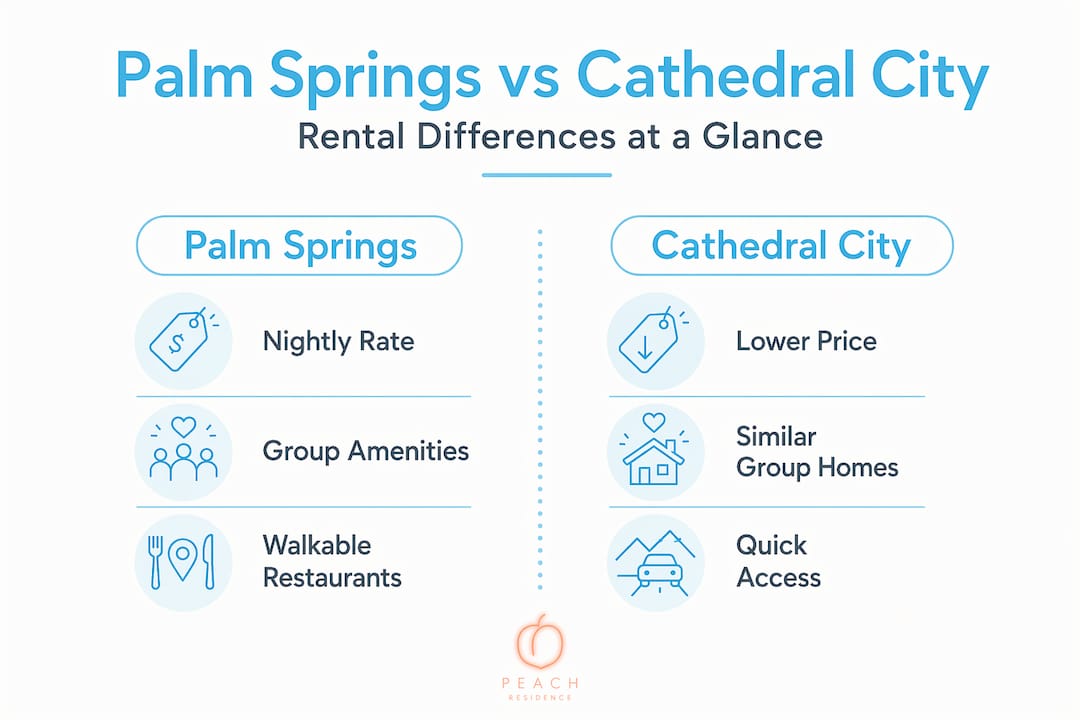
Palm Springs proper carries a price premium. The name recognition, the mid-century architecture, the walkable restaurant scene, all of it is built into the nightly rate. But proximity to all of that does not require paying for the address.

Budget-conscious travelers can find significant savings by looking at nearby cities like Cathedral City, which sits about 10 minutes east and offers a quieter, more residential atmosphere with noticeably lower rental rates. For a group splitting costs, that gap adds up fast.
Here is a rough comparison to help frame your decision:
| Factor | Palm Springs | Cathedral City |
|---|---|---|
| Avg. nightly rate (group home) | $400 to $700+ | $250 to $450 |
| Neighborhood vibe | Lively, walkable, touristy | Quiet, residential, laid-back |
| Drive to Palm Springs attractions | 0 min | 10 to 15 min |
| STR permit environment | Highly regulated, limited supply | Somewhat more available |
| Mountain views | Common | Available, especially north-facing |
| Per-person cost (8 guests) | $50 to $88+/night | $31 to $56/night |
The tradeoff is real but manageable. You are not giving up the desert experience. You are giving up the ability to walk to dinner, which most groups end up driving to anyway.
Things to factor into your total cost comparison:
- Some Palm Springs rentals include utilities; others charge separately for air conditioning, which runs constantly in summer.
- Cleaning fees and service fees can add 20 to 35% on top of the nightly rate regardless of location.
- Parking is free at most residential rentals, unlike hotels in the downtown core.
- If your group plans to cook, a full kitchen at either location saves significantly compared to dining out every meal.
Pro Tip: When comparing listings side by side, always look at the total cost for your stay, including fees, not just the nightly headline rate. A $300/night listing with $400 in fees for a 3-night stay can cost more than a $380/night listing with $150 in fees.
If you want to see what best Palm Springs mountain-view rental options look like in practice, there are properties outside the city center that deliver the scenery without the premium address surcharge. And for inspiration on planning Palm Springs desert getaways, the options are broader than most first-time visitors expect.
Planning your group stay: legal booking, neighborhood etiquette, and cost-saving tips
Getting the booking right is only half the job. The other half is making sure your group actually enjoys the trip without running into issues with the host or the neighbors.
- Verify the Permit ID. Before you pay a single dollar, find the city-issued Permit ID on the listing. Guests must verify a valid city-issued Permit ID and follow all applicable house rules. It should be visible in the listing text or the booking confirmation. If it is missing, contact the host and ask directly.
- Read the house rules, all of them. Occupancy limits are enforced. If the listing says 8 guests and you show up with 12, the host can ask people to leave or terminate the booking.
- Understand the Good Neighbor Policy. Palm Springs enforces noise restrictions that prohibit amplified outdoor music. That includes Bluetooth speakers on the patio after quiet hours. Groups that violate this can trigger complaints that affect the host's permit status.
- Book off-peak when possible. May, June, and September offer meaningful discounts compared to the January to April high season. Summer is hot, but evenings are spectacular and prices can drop 30 to 40%.
- Plan transportation before you arrive. Car rentals from Palm Springs International Airport carry a premium. If your group is driving from LA or San Diego, coordinating two vehicles from home is almost always cheaper than renting locally.
For a full walkthrough of what to expect when you arrive, the guide on booking perfect Palm Springs group getaway and tips on Palm Springs group arrival workflow are genuinely useful for first-timers.
What makes a Palm Springs rental ideal for groups seeking desert adventures and relaxation
There is a reason Palm Springs vacation rentals have become the default choice for group trips over hotels. Vacation rentals provide flexible lodging for multi-generational travel and unique neighborhood experiences that blend relaxation with real desert adventure. A hotel room is four walls. A rental is a home base.
What to look for when choosing a group rental:
- Multiple bedrooms with distinct personalities. Four bedrooms do not have to feel identical. Rentals that give each room its own character mean everyone has a space they actually like retreating to.
- Private outdoor space. A pool, patio, or both is non-negotiable for most desert trips. Evening swims after hiking are the entire point.
- Air conditioning that works well. Desert heat is serious from May through October. Check that the AC system can handle the full house, not just the bedrooms.
- Proximity to activities. The best rentals put hiking at Joshua Tree, spa days, golf courses, and the Aerial Tramway all within a reasonable drive without being so central that you pay downtown prices.
- Quiet cul-de-sac or end-of-street locations. Less traffic noise, more privacy, and neighbors who are not directly in your sightline.
Seasonality also matters more than most first-time visitors realize. High season runs roughly October through April when temperatures are ideal. Summer brings the heat but also the best rates and dramatically smaller crowds. For groups focused on Palm Springs serene retreat experiences, the shoulder seasons of May and October are genuinely the sweet spot.
Our honest take on the Palm Springs rental market
Here is something the typical rental guide will not tell you: the permit system that frustrates hosts is actually good for you as a group traveler.
Because Palm Springs limits supply through neighborhood caps and contract limits, the hosts who survive in this market are the ones who take the experience seriously. Sloppy operators get fined, flagged, or lose their permits. What remains is a market with higher average quality than most vacation rental cities. When you find a well-reviewed, permitted property that commits to the indoor/outdoor desert lifestyle, you are not just getting a place to sleep. You are getting something the host has invested real effort into.
The trap most groups fall into is optimizing only for price and ignoring the permit verification step. An unpermitted listing is not a bargain. It is a liability. Your booking can be canceled with no warning if the city finds the property, and the host has no legal standing to help you.
The other trap is booking too late. Groups from LA and San Diego often treat Palm Springs like a spontaneous weekend trip. It can be, but the best properties with mountain views, multiple bedrooms, and proper outdoor space get booked two to three months out during the October to April window. Spontaneous works in summer. For peak season, plan ahead.
Stay where the views actually earn the rate
If you are bringing 8 people to the desert, the math gets interesting fast. At $65 per person per night, a Peach Residence group rental gives you four bedrooms, mountain views that run wall to wall, and a private end-of-the-cul-de-sac position with exactly one neighbor. No city lights bleeding into the night sky. No noise you did not create.
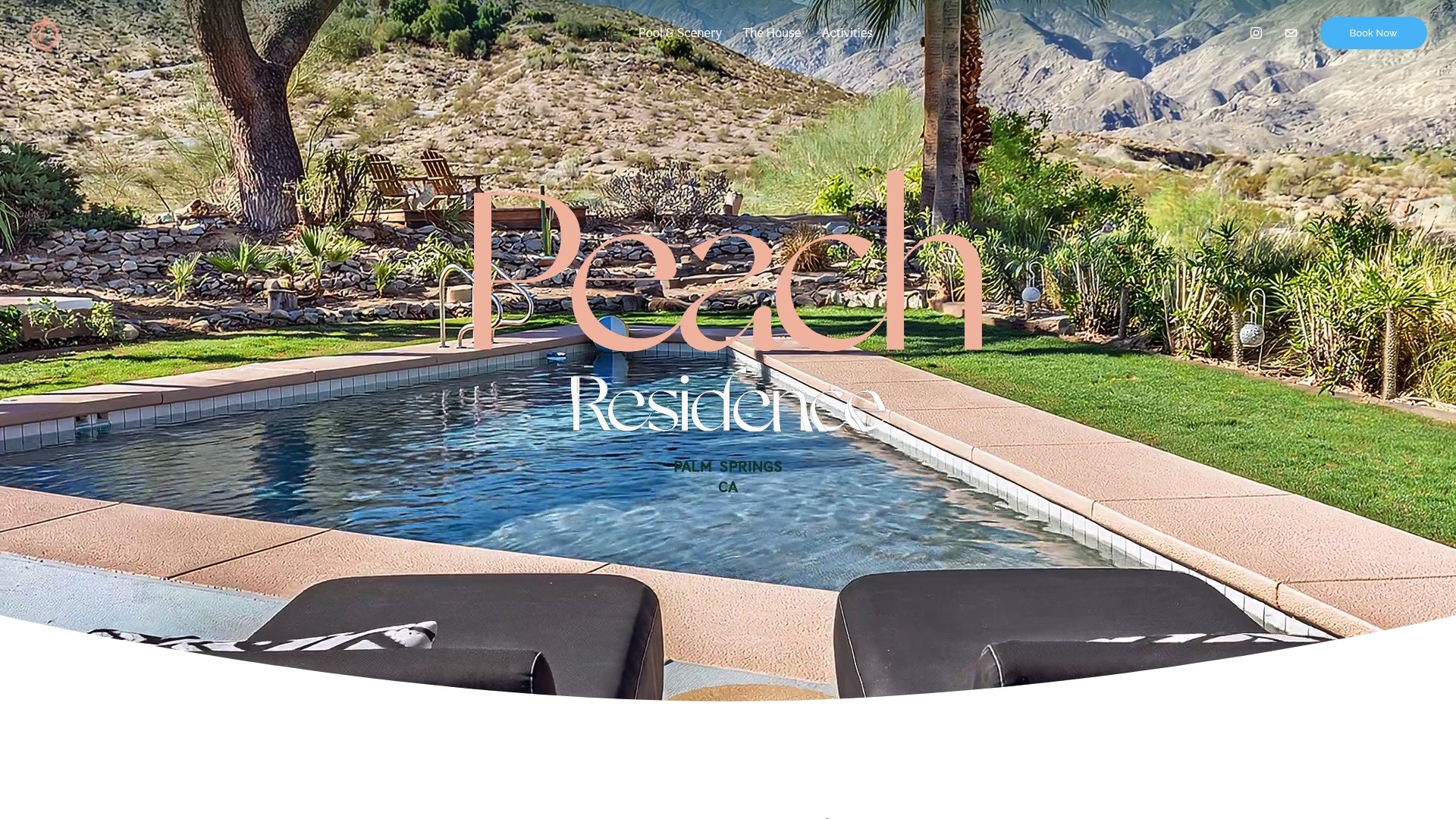
Freshly updated in 2025, it fully commits to the Palm Springs indoor/outdoor lifestyle. Doors open, desert breeze in, the kind of space where the group actually hangs out together instead of retreating to separate hotel rooms. It is a legal, permitted rental with a track record, which means no surprises at check-in. If you want to compare it against what else is out there, start with the view. Most listings cannot compete on that alone.
Frequently asked questions
What is considered a short-term rental in Palm Springs?
A short-term rental in Palm Springs is any residential property rented for 28 days or fewer, requiring a valid city-issued permit to operate legally.
Are there rental permit limits that affect availability in Palm Springs?
Yes. Neighborhood caps limit rentals to 20% of residential units per area, and full STR permits are capped at 26 booking contracts per year, both of which restrict how many properties are available at any given time.
How can group travelers find more affordable rentals near Palm Springs?
Groups can save significantly by looking at Cathedral City, about 10 minutes from Palm Springs, where nightly rates run noticeably lower while still offering easy access to all the main attractions.
What should guests do to ensure their Palm Springs rental booking is legal?
Guests should confirm a valid Permit ID appears on the listing before booking, and review all house rules carefully, particularly noise restrictions and occupancy limits, to avoid any disruption to their stay.